
Advanced Hernia & Minimally Invasive Surgery
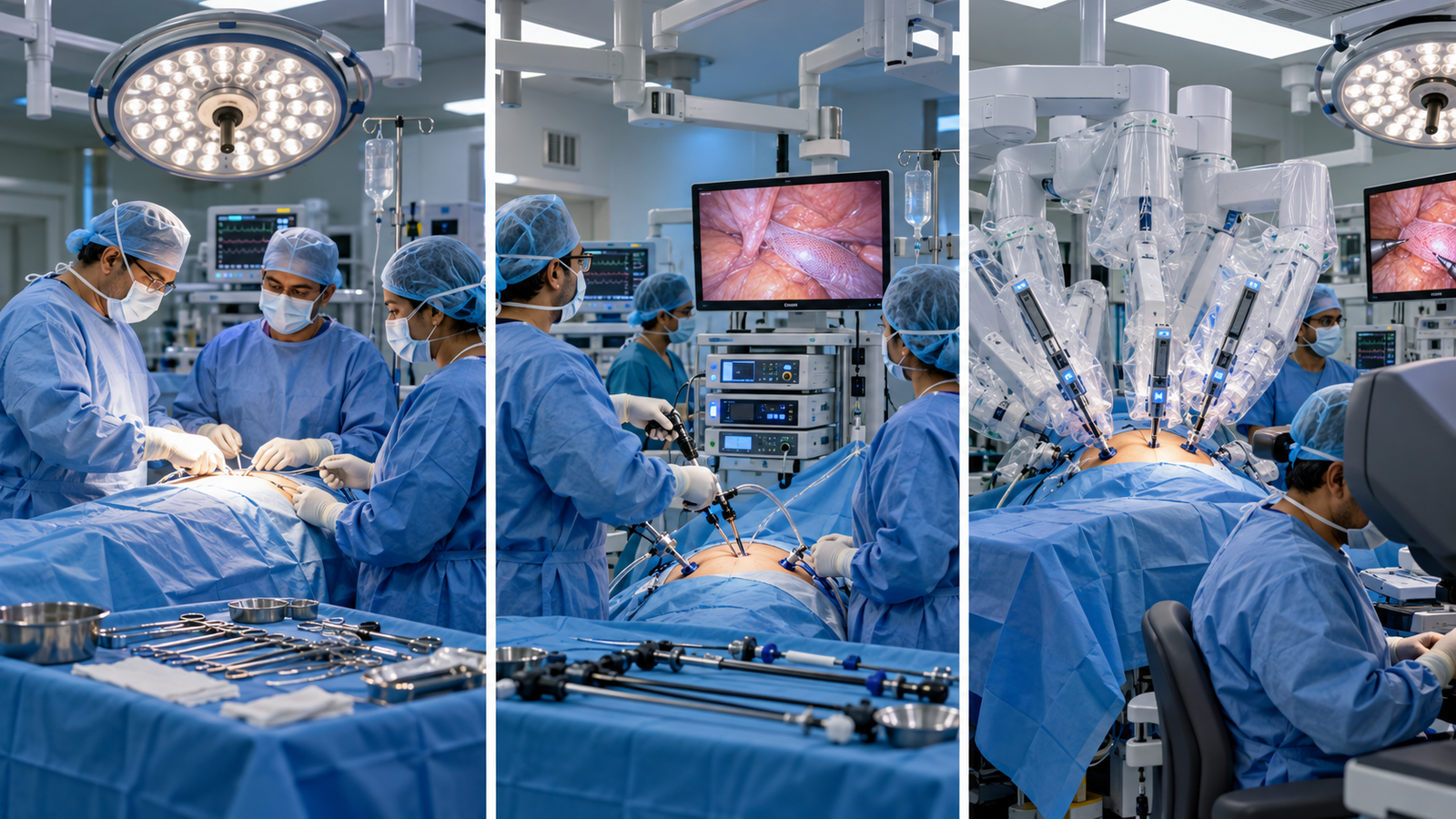
Introduction: Hernia Surgery Has Changed—but Has “Newer” Always Meant “Better”?
Hernia surgery has travelled a remarkable path.
What once required a relatively large incision can now, in suitable patients, be repaired through a few small openings using laparoscopic surgery or a robotic surgical system.
Modern hernia treatment, however, is not simply a story of one technique replacing another.
Open hernia repair is still valuable. Laparoscopy transformed minimally invasive repair. Robotics has added another advanced surgical platform.
The real progress has been learning how to choose the right repair for the right patient.
Modern evidence continues to show that no single hernia technique is best for everyone. The surgeon's experience, hernia type, previous operations, patient health and available technology all matter.
What Is a Hernia?
A hernia happens when tissue pushes through a weak area in the surrounding muscle or abdominal wall.
Common types include inguinal, umbilical, incisional and ventral hernias.
Symptoms
A patient may notice a swelling or bulge, discomfort while standing, pain while coughing or lifting, or a feeling of heaviness around the affected area.
A suddenly painful lump that cannot be pushed back, particularly with vomiting or abdominal swelling, needs urgent medical assessment.
Causes
Hernias can develop because of natural weakness in the abdominal wall, previous surgery, ageing, repeated straining, chronic coughing, pregnancy or increased pressure inside the abdomen.
Diagnosis: Choosing the Repair Starts Before Surgery
Many hernias can be diagnosed through a physical examination.
Ultrasound or CT scanning may sometimes be needed for unclear, recurrent or complex hernias.
But diagnosis is only the first step.
The surgeon must also ask:
Is open repair, laparoscopy or robotic repair most appropriate for this patient?
Stage 1: Open Hernia Repair—The Foundation
Modern hernia surgery was shaped by surgeons such as Edoardo Bassini, whose repair was introduced in the late 1800s.
Another major step came with the tension-free mesh repair, associated with Irving Lichtenstein in the 1980s. Instead of pulling tissues tightly together, mesh could reinforce the weak area with less tension.
During open hernia repair, the surgeon makes an incision over or near the hernia and repairs the weakened area directly.
Open surgery remains important today.
It can be particularly useful when local or regional anaesthesia is preferred, in certain recurrent hernias, complex situations, or where minimally invasive technology is unavailable.
Old does not mean outdated.
A well-performed open repair remains an excellent operation for appropriately selected patients.
Stage 2: Laparoscopy—Hernia Surgery Through Small Incisions
The next major change was laparoscopic hernia repair.
Instead of approaching the hernia through one larger incision, surgeons began using a camera and long instruments through several small openings.
Modern laparoscopic groin-hernia techniques include TAPP (Transabdominal Preperitoneal Repair) and TEP (Totally Extraperitoneal Repair). TAPP developed rapidly during the early 1990s and became one of the major modern approaches to inguinal hernia surgery.
For suitable patients, minimally invasive repair can offer benefits such as smaller incisions, less postoperative discomfort in some settings, shorter hospital stay and earlier return to normal activities. SAGES also identifies reduced wound problems as a potential advantage for minimally invasive ventral hernia repair.
Laparoscopy can be particularly useful for bilateral groin hernias and selected recurrent hernias.
Stage 3: Robotic Hernia Surgery—The Latest Step
Robotic hernia surgery builds on the principles of minimally invasive surgery.
The robot does not operate by itself.
The surgeon sits at a console and controls the instruments throughout the procedure.
Robotic systems can provide a magnified three-dimensional view and highly articulated instruments, which may make suturing and working in difficult spaces easier for the surgeon.
This can be useful in selected complex abdominal-wall reconstructions.
But there is an important point patients should know:
Robotic surgery is not automatically better than laparoscopy.
A 2026 systematic review of randomized trials comparing robotic and laparoscopic inguinal hernia repair found no statistically significant difference in overall complications, recurrence or same-day discharge, although the certainty of evidence was low to very low.
Other recent evidence also reports broadly similar patient outcomes while noting longer operating times and higher procedural costs with robotic repair.
So robotics should be viewed as another surgical tool, not a guaranteed upgrade for every hernia.
Open vs Laparoscopic vs Robotic Hernia Repair
|
|
|
|
|
|
|
|
|
|
|
|
|
|
|
|
|
|
|
|
|
|
|
|
|
|
|
|
|
|
|
|
|
|
|
|
|
|
|
|
Evidence comparing modern techniques supports individualising the operation rather than declaring one universal winner.
Benefits: What Has This Evolution Achieved?
The biggest improvement in hernia surgery is not simply smaller scars.
Modern techniques have given surgeons more choices.
A patient who is better suited to open surgery can still receive an established repair. Another patient may benefit from TEP or TAPP laparoscopy. A complex abdominal-wall case may sometimes benefit from robotic capabilities.
That ability to personalise surgery is the real advancement.
Recovery
Walking usually begins early after uncomplicated hernia repair.
Minimally invasive approaches may allow an earlier return to normal activity in suitable patients, but recovery depends on the hernia type, repair complexity and patient's overall health, not simply whether a robot was used.
Patients should follow their surgeon's advice regarding lifting, exercise, driving and work.
Possible Complications
All three approaches can have complications.
These may include bleeding, infection, seroma, persistent pain, injury to nearby structures and hernia recurrence.
Minimally invasive surgery also requires general anaesthesia in most cases, while open repair may sometimes be performed under local or regional anaesthesia.
The safest operation is therefore the one selected after proper examination—not automatically the newest one.
From Bigger Cuts to Better Choices
The journey of hernia surgery from open repair to laparoscopy and robotics shows how surgery has evolved.
But progress does not mean throwing away older methods.
Open repair laid the foundation.
Laparoscopy brought minimally invasive surgery forward.
Robotics expanded what surgeons can do through small incisions.
Today, the goal is not to use the most expensive or newest technology.
It is to choose the safest, most appropriate and evidence-based repair for each patient.
Patients considering hernia surgery in Visakhapatnam can discuss available open and minimally invasive approaches with Dr. Naveen Kumar Anem, MBBS, DNB (General Surgery), FMAS, FIAGES, Laparoscopic & GI Surgeon, based on their individual diagnosis.
Have a Hernia and Wondering Which Surgery Is Right for You?
Do not choose an operation simply because it is labelled open, laparoscopic or robotic.
Get the hernia properly evaluated and ask which approach offers the best balance of safety, recovery, durability and surgical expertise for your particular condition.
!! BOOK YOUR APPOINTMENT TODAY !!
Medical Review
Use after Dr. Naveen Kumar Anem has personally reviewed and approved the final article:
✅ Medically Reviewed by Dr. Naveen Kumar Anem
MBBS, DNB (General Surgery), FMAS, FIAGES
Laparoscopic & GI Surgeon
This article is intended for general patient education. The appropriate hernia repair technique varies by patient and should be selected after examination by a qualified surgeon.